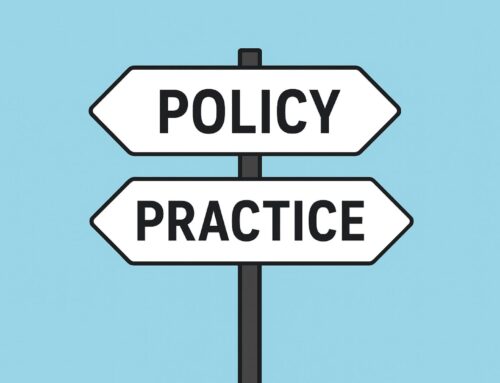

In practice, you do not always get the culture you created at a retreat. You get the culture you incentivize. This idea is rarely obvious to people inside the organization, who often struggle to “read the label from inside the bottle.” As outside consultants, we frequently observe patterns that internal teams miss: policies say one thing, but incentives, pressures, and metrics quietly encourage something else. In those moments, people do not experience the culture written in the handbook; they experience the one shaped by daily survival.
Policies, even well-intentioned ones, can fail when the systems beneath them reward the opposite behavior. A policy doesn’t operate in a vacuum. It interacts with resource constraints, leadership priorities, compensation plans, and operational demands. When those elements conflict, the policy becomes little more than an aspirational statement while the practice becomes the real instruction manual. Let’s look at a few examples where misalignment not only frustrated workers, it led to legal exposure, reputational damage, and strategic setbacks.
When Incentives Quietly Rewrite the Culture
Wells Fargo experienced the exposure, damage, and setbacks when it allowed a culture grounded in integrity to collide with internal systems that rewarded something very different. Wells Fargo publicly championed customer trust and ethical conduct, yet internally tied employee success to aggressive quota-driven account openings. It was this incentivized system, not their stated values, that guided behavior in the end.
Employees opened nearly two million unauthorized accounts, not because they rejected the culture, but because the incentives made that behavior the most direct path to success. This reflects a classic moral hazard: when the personal upside of misconduct outweighs the perceived downside, even good people may take actions that conflict with policy.
A similar dynamic unfolded in the mining industry, where BHP introduced a wage-increase incentive tied to production goals. On paper, it appeared to motivate excellence. In reality, a simultaneous hiring freeze made those goals unreachable. Employees found themselves caught between a policy that promised reward and a system that guaranteed failure.
The outcome was not increased performance but frustration, burnout, and disengagement. Natural responses when the practice of resourcing undermines the policy of reward.
Xerox also ran into the issue, again created by resource priorities. As Xerox attempted to reposition itself as an innovation leader, it promoted a policy narrative centered on transformation and new market opportunities. Yet its salesforce was financially rewarded for selling legacy products with richer commissions and shorter sales cycles. Predictably, revenue efforts gravitated toward the older offerings. The behavior was not resistance to change; it was a textbook principal–agent problem. The organization wanted long-term strategic repositioning, but the agents, the salesforce, followed the incentive structure that maximized their earnings.
Why Good Intentions Are Not Enough
Across industries, the same pattern emerges: systems speak louder than slogans. Incentives, recognition, and metrics quietly define what “success” really means, often more powerfully than mission statements or cultural declarations. Employees typically want to support the organization’s goals, but they also want to succeed in the environment leadership has created. When systems and values diverge, culture follows the paycheck, not the poster.
This doesn’t happen because leaders lack integrity or because employees disregard policy. It happens because systems shape human behavior with far more consistency than ideals do. People respond rationally to the structures that determine their opportunities, their job security, and their advancement.
Aligning Systems With Values
Leaders who want to close the gap between policy and practice must look beyond the words of the policy itself. They must examine the ecosystem shaping behavior: what people are measured on, what earns praise, how workloads are structured, and which outcomes are consistently rewarded. Culture becomes coherent when these elements reinforce the values the organization claims to hold. When they contradict them, culture fractures.
The path forward isn’t to blame departments or reprimand employees for following the incentives placed in front of them. It’s to treat every disconnect as useful data. Misaligned behaviors are signals. They are indicators of where systems are out of sync with values. When leaders respond with curiosity instead of judgment, they can redesign the environment so employees can succeed the right way, not just the rewarded way.
In the end, the culture an organization keeps is not the one it announces. It’s the one its systems enable, reinforce, and reward every single day.